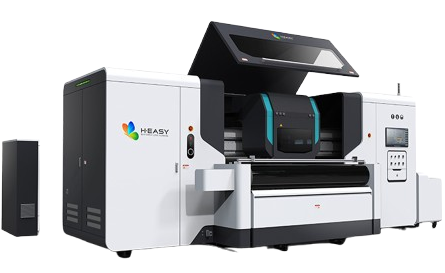
How to Choose the Right Fabric Printing Machine: H-1808 vs H-1816 vs H-1832 vs H-2632
Choose an H-Series model by fabric width, ink chemistry, pass mode and required sellable output. H-1808 is positioned for sampling and lower volume, H-1816 for 1.8 m production, H-1832 for higher-head 1.9 m work, and H-2632 for 2.6 m home textiles. Final capacity must be qualified with the same fabric, coverage, quality target and finishing line.
Quick comparison
| Model | Width | Heads | 2-pass reference | 3-pass reference | Best for |
|---|---|---|---|---|---|
| H-1808 | 1.8 m | 8 × Ricoh Gen6 | 170 m²/h | 120 m²/h | Sampling and lower-volume work |
| H-1816 | 1.8 m | 16 × Ricoh Gen6 | 330 m²/h | 200 m²/h | Production requiring more head capacity |
| H-1832 | 1.9 m | 32 × Ricoh Gen6 | 650 m²/h | 450 m²/h | Higher-head industrial production |
| H-2632 | 2.6 m | 32 × Ricoh Gen6 | 650 m²/h | 450 m²/h | Wide home-textile work |
The current published maximum remains 650 m²/h at 2-pass. These are reference speeds, not guaranteed sellable output. Qualify the model, fabric, ink, coverage, feathering, environment and acceptance criteria.
H-1808 - Entry-level
Best for: startups, sampling studios, businesses testing pigment or reactive workflows.
- 8 Ricoh Gen6 industrial heads, 1.8 m width
- Current reference: 170 m²/h at 2-pass, 120 m²/h at 3-pass
- Lower investment threshold than the higher-head models
- All H-Series industrial features (constant tension, web guiding, adhesive belt)
Step up to H-1816 when the qualified H-1808 output becomes the bottleneck or when sample-validated SKUs are graduating to sustained production.
H-1816 - Production workhorse
Best for: factories with stable daily output, silk fashion brands, balanced speed-to-quality workloads.
- 16 Ricoh Gen6 heads, 1.8 m width
- Current reference: 330 m²/h at 2-pass, 200 m²/h at 3-pass
- More head capacity than H-1808 for sustained production workloads
- Multiple width / configuration options available
Choose it when 1.8 m width is sufficient and the verified H-1808 capacity does not cover the order plan. It is not an automatic default without a line study.
H-1832 - High-speed industrial
Best for: large factories running bulk orders, mass-production fashion mills.
- 32 Ricoh Gen6 heads, 1.9 m width
- Current published maximum: 650 m²/h at 2-pass
- Current 3-pass reference: 450 m²/h
- Higher capex, but lower per-m² production cost at full utilization
Step up from H-1816 to H-1832 when 16-head capacity becomes a bottleneck or when bulk-order contracts justify the additional headroom.
H-2632 - Wide-format production
Best for: home textile manufacturers - curtains, bedding, tablecloths, wide cushions.
- Same 32-head Ricoh Gen6 engine as the H-1832, at 2.6 m width
- Current 2-pass reference of 650 m²/h on appropriate fabric
- Targets fabrics that don’t fit a 1.8–1.9 m machine cleanly
- Industrial-level wide-format configuration
If your fabric is consistently 1.8 m or narrower, H-1832 is the more appropriate flagship. The H-2632’s value comes specifically from the wider web.
How pass mode changes output
Lower-pass modes generally prioritize speed, while higher-pass modes generally prioritize coverage and image quality. The usable setting depends on fabric, ink chemistry, artwork and acceptance criteria. The quotation and sample test should therefore state the pass mode beside every published speed.
Decision factors
- Daily production capacity needed - match model output range to honest order flow
- Fabric width - 1.8 m default, 1.9 m for H-1832, 2.6 m for home textile
- Quality-vs-speed priority - more heads = more options, both directions
- Business stage - startup (H-1808), growth (H-1816), scale (H-1832), wide format (H-2632)
- Ink workflow - specify reactive, disperse, acid or pigment at line configuration; frequent chemistry switching is not recommended