How Much Does Pigment Ink Printing Cost per Square Meter?
Pigment textile printing typically costs about $0.58/m² all-in in a production-scale factory setup. That covers ink, pretreatment, drying and fixation energy, labor and machine time, and maintenance and waste. The breakdown below is the planning baseline; real factories vary ±20% based on coverage, energy cost and utilization.
All-in cost breakdown
| Cost line | Per m² |
|---|---|
| Ink | ~$0.30 |
| Pretreatment | ~$0.10 |
| Drying / fixation energy | ~$0.05 |
| Labor / machine time | ~$0.08 |
| Maintenance / waste | ~$0.05 |
| Total | ~$0.58 |
Cost line details
Ink (~$0.30/m²)
Reference consumption: 20 g of ink per m² of fabric - at $15/kg ink, that’s $0.30/m². See how much pigment ink is used per square meter of fabric for the consumption math.
Variance: light-coverage designs consume less; heavy dark patterns consume more. Cotton consumes more than polyester at the same visible output. Premium ink stocks at $18–$20/kg push the line item to $0.36–$0.40/m².
Pretreatment (~$0.10/m²)
Pretreatment chemistry, plus the water, energy and labor to apply and dry it before printing. Typical formula: 5% modifying liquid in water, applied to fabric, dried before print. The pretreatment improves color yield, pattern sharpness and fixation stability - skipping it is usually a false economy.
Drying and fixation (~$0.05/m²)
After printing, fabric is dried (≈140 °C / 5 min) and then heat-fixed (130–150 °C / 4–6 min) to activate the binder system. Heat-fix is the single biggest fixed-cost-per-m² energy line. The exact number depends on:
- Heat source (electric vs natural gas)
- Fabric thickness and weight
- Line speed and machine type
Labor and machine time (~$0.08/m²)
Operator labor at the printer, plus the depreciation of the printer itself amortized over produced m². At full utilization, machine depreciation drops; at low utilization, it climbs sharply.
Maintenance and waste (~$0.05/m²)
Printhead replacement amortization, ink filter changes, scheduled service, scrap and defect rework.
Cost variance levers
| Lever | Effect |
|---|---|
| Heavy / dark coverage artwork | Up to 2× ink line cost |
| Low machine utilization | Up to 2× labor / machine line |
| Premium ink stocks | +20–30% ink line |
| High electricity cost | +30–50% fixation energy line |
| Skilled operator vs trainee | ±20% labor productivity |
Comparison with traditional methods
Pigment printing eliminates the wash and steam steps required by reactive printing. Those steps cost water, wastewater treatment, energy and labor - usually offsetting pigment’s marginally higher ink cost per kg. Net total-cost-per-m² tends to favor pigment in modern factory setups. See how no-wash pigment printing reduces production cost for the full process comparison.
Production hardware
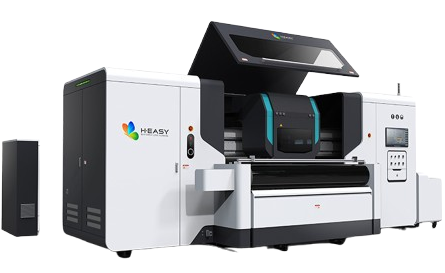
For industrial pigment printing capable of running at the cost levels above, see the H-Series R2R printers
- 1.8–2.6 m Ricoh Gen6 platforms with reactive, disperse, acid and pigment ink workflows. At full utilization, the per-m² cost drops below the baseline; at low utilization, the machine-line cost dominates.
Conclusion
$0.58/m² is the planning baseline for pigment textile printing. Coverage heaviness, machine utilization and energy cost are the three variables that swing real factory numbers. Build the per-m² number around your actual workload, not just the headline ink price.