60cm DTF Printer: Buying Guide & Key Considerations
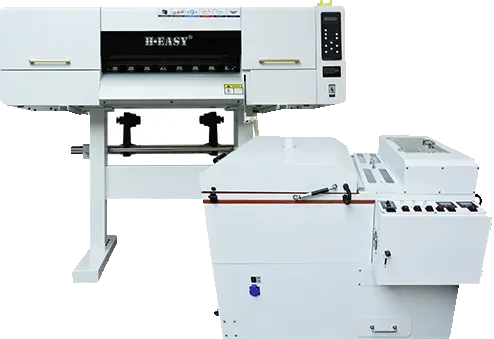
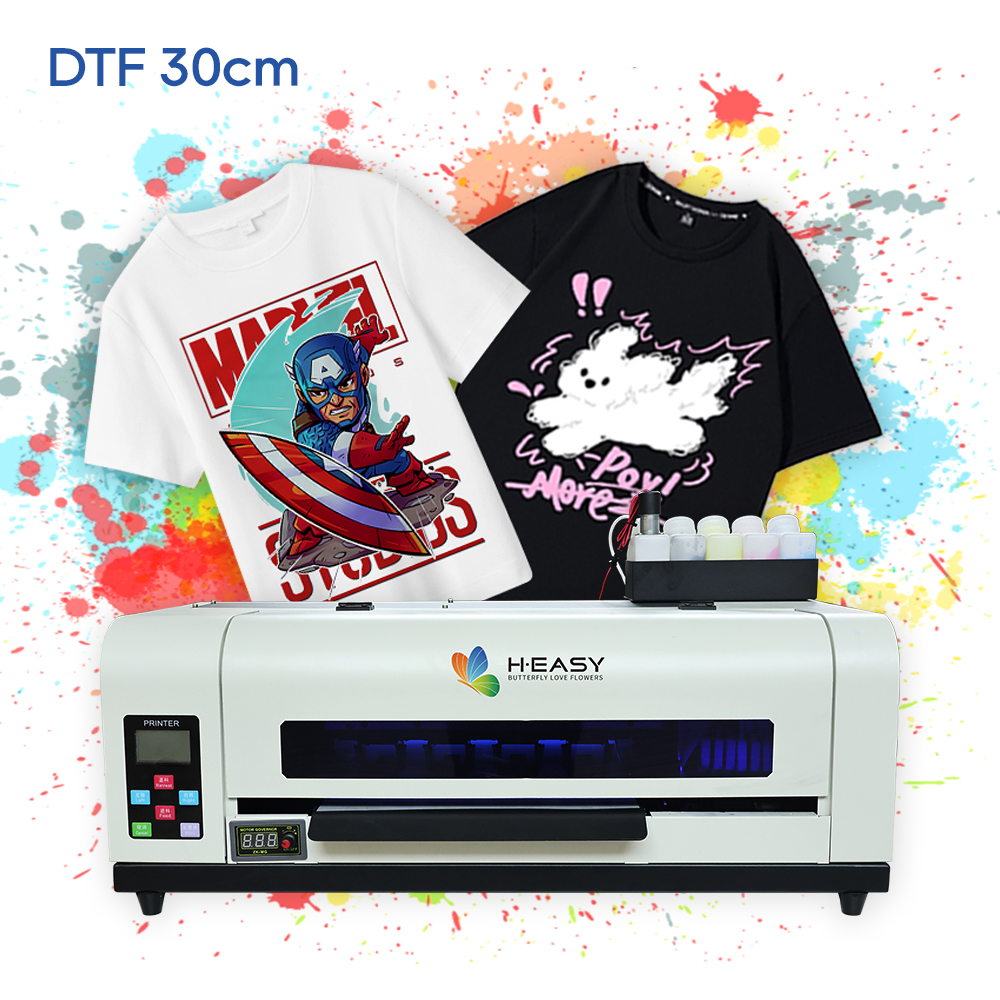
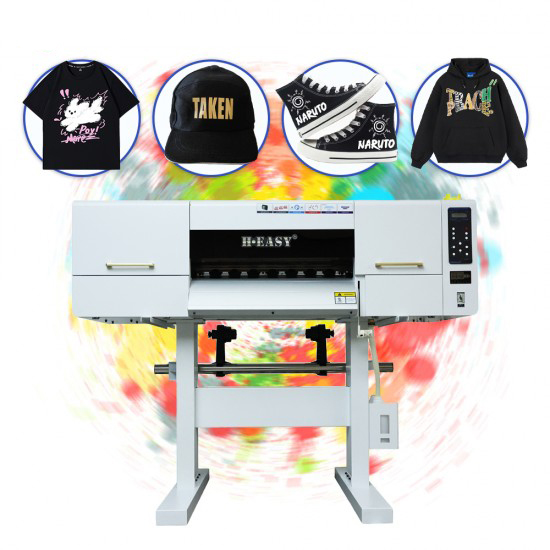
A 60 cm DTF printer is a production-grade direct-to-film printer with a 600 mm print width, typically dual industrial printheads and an integrated powder shaker. It targets daily volume output for textile transfer printing - the standard step up from a 30 cm desktop DTF when one shift’s output stops fitting on the smaller machine. This guide covers what to evaluate before buying one in 2026.
What is a 60 cm DTF printer?
DTF (direct-to-film) printers print CMYK + white artwork onto a PET transfer film. The film is then dusted with hot-melt adhesive powder, cured, and heat-pressed onto fabric. A 60 cm DTF printer does this at 600 mm web width, which is wide enough to:
- Print most adult-garment graphics edge-to-edge without tiling.
- Run multiple smaller transfers gang-printed across the web.
- Sustain production throughput a desktop machine can’t match.
HY-702 reference specs
Our HY-702 60cm DTF printer is a representative example of the class:
| Spec | Value |
|---|---|
| Print width | 600 mm |
| Printheads | 2 × Epson i3200-A1 |
| Ink mode | CMYK + White |
| Media | PET transfer film |
| Print speed | 22 m²/h (4-pass) · 15 m²/h (6-pass) |
| Ink supply | Continuous tank with HyCIRC™ white-ink circulation |
| Power | AC 220 V ±10% · 50/60 Hz |
| Powder shaker | Integrated, inline; 4.5 kW heating system |
The integrated powder shaker matters: a separate standalone shaker takes floor space, adds a manual handoff step, and is a frequent bottleneck on otherwise fast printers.
Key advantages of a 60 cm DTF over a 30 cm desktop
- Larger printing area - fits hoodies and oversize graphics without tiling.
- Higher production efficiency - dual heads typically run 5–10× the throughput of single-XP600 desktop units.
- More stable ink supply - large continuous tanks plus white-ink recirculation are standard at this class; sedimentation is much rarer.
- Industrial machine structure - heavier frame, better feed control, and carriage systems sized for 8+ hour shifts.
Typical applications
DTF prints adhere well to cotton, polyester, polyester blends, canvas, denim and many synthetic fabrics. Common 60 cm-class production runs include:
- T-shirts, hoodies and sweatshirts
- Hats, beanies and caps
- Tote bags and accessories
- Sportswear and performance apparel
- Children’s apparel and kidswear
- Custom workwear and uniform graphics
Unlike DTG, DTF generally does not require fabric pretreatment - the hot-melt powder layer is what bonds to the textile.
30 cm vs 60 cm: which width should you buy?
Choose 30 cm DTF (e.g. HY-401) when:
- You’re sampling, prototyping or doing custom one-offs.
- Daily volume fits inside a 1 m²/h-class machine.
- Bench footprint and entry cost matter more than throughput.
- You want to add DTF as a second process alongside DTG or sublimation.
Choose 60 cm DTF (e.g. HY-702) when:
- Daily output is too much for a desktop to clear in a shift.
- You’re printing adult-garment graphics that don’t fit cleanly at 30 cm.
- You want to gang multiple small transfers across the web.
- Continuous ink, white-ink circulation and an inline shaker are required to meet uptime targets.
What to evaluate when buying
- Printhead model and count. Dual Epson i3200-A1 is the production standard at 60 cm. Single XP600 setups belong in the desktop class.
- White-ink reliability. Circulation system, degassing and burn-in procedure matter more than the headline speed number.
- Powder shaker integration. Inline shaker vs separate standalone shaker changes both floor space and throughput.
- Consumable cost per m². Add film, powder, ink and maintenance into per-piece cost - not just the headline machine price.
- Support and parts lead time. Require the quotation to state stock, destination, dispatch target and remote-commissioning scope.
- Burn-in and warranty. A 72-hour factory burn-in and 12-month warranty should be standard at this class.
Conclusion
A 60 cm DTF printer is the right step up when desktop output stops keeping pace, you want larger graphics without tiling, or you need industrial uptime on white-ink work. Match printhead, white-ink system, shaker integration and support to your daily volume - not to the headline speed number.
Compare specs and request a quote on the HY-702 60cm DTF printer, or start with the HY-401 30cm desktop DTF printer if you’re sampling or running smaller daily volume.
Related production guides
Printers matched to this guide