Why Pigment Ink Printing Is Making a Comeback in the Textile Industry
Pigment ink printing now accounts for about 10% of the digital textile printing market and is growing fast. The drivers: tighter environmental regulations, a no-wash workflow, lower water / energy / labor cost, and ink-chemistry improvements that fixed the historical limitations on hand feel, color and fastness. This post walks why pigment is moving from niche to mainstream.
What changed
Pigment ink isn’t new - it’s been around for decades, used historically on screen-printed T-shirts and similar lower-fidelity garment work. What changed in the last 5–10 years:
- Ink chemistry - finer pigment dispersion, modern polyurethane and acrylic binders, surfactant systems that hold the ink in inkjet printheads without clogging.
- Process knowledge - better understanding of pretreatment chemistry and heat-fix energy management means modern pigment prints hit acceptable color depth and softness.
- Environmental pressure - tightening regulations make the no-wash workflow a structural advantage, not a nice-to-have.
- Fast-fashion economics - shorter production cycles favor pigment over the multi-step reactive process.
The four drivers
1. Environmental regulation
Pigment printing’s headline environmental advantage is minimal wastewater. Reactive, disperse and acid printing all require washing to remove unfixed dye - generating dye-laden wastewater that needs treatment. Pigment’s heat-fix step needs no wash, so no dye effluent leaves the line.
For mills in jurisdictions with strict wastewater regulation, this isn’t a cost optimization - it’s a permission-to-operate factor.
2. Simplified workflow
Compare:
| Step | Reactive | Pigment |
|---|---|---|
| Sizing | ✓ | ✓ |
| Printing | ✓ | ✓ |
| Steaming | ✓ | - |
| Washing | ✓ | - |
| Drying | ✓ | ✓ |
| Fixation | ✓ | ✓ |
| Finishing | ✓ | - |
Three steps eliminated. Each removal means less floor space, less equipment, less operator time and lower defect-introduction risk.
3. Cost reduction
Pigment ink is typically more expensive per kg than reactive - but the process eliminations save more than the ink premium costs. Total per-m² cost favors pigment in modern factory setups; see how much does pigment ink printing cost per square meter.
4. Market demand
Fast-fashion and small-batch / high-SKU production reward fast turnaround. Pigment’s shorter cycle and broader fabric compatibility both serve that demand. Apparel brands moving toward print-on-demand models particularly favor pigment because they can run mixed-fabric SKUs through one process.
Remaining limitations
Pigment isn’t replacing reactive everywhere:
- Premium cotton fashion still favors reactive for deeper color saturation and softer hand
- High-end silk still favors acid for color brilliance and soft drape
- Brand-specified contracts often still call for reactive explicitly
The historical limitations - rigid hand, dull color, weak fastness - have narrowed dramatically but haven’t fully closed. Pigment vs reactive is now a trade-off rather than a quality gap.
Equipment innovation
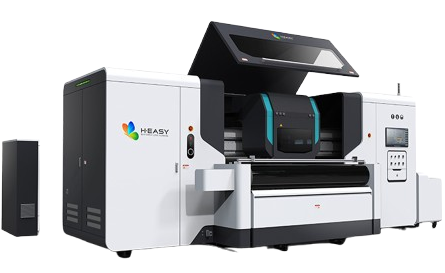
Modern industrial pigment printers ship with features purpose-built for the chemistry: stable ink supply with degassers, white-ink circulation to prevent sedimentation, controlled-temperature print zones, and integrated heat-fix dryers. The H-Series R2R printers are an example - 1.8–2.6 m Ricoh Gen6 platforms designed for reactive, disperse, acid AND pigment workflows on the same machine class, so factories can switch ink chemistry per job rather than per machine.
Outlook
Pigment’s share of digital textile printing is structurally trending up. The combination of environmental compliance, cost economics and process simplicity is a hard combination for reactive to beat outside premium segments. Expect pigment to keep gaining share, particularly in regions with strict wastewater regulation and short-cycle production.